 Masai Mara Safari
Home › Guides › When Is the Best Time to Visit the Masai Mara for a Safari?
When Is the Best Time to Visit the Masai Mara for a Safari?
The Best Time To Visit Masai Mara Safari is the dry stretch from June to October, when animals gather at rivers and waterholes and the grass is thin enough to see far. Mara Conservancy says the Great Migration reaches the Mara Triangle by the Sand River around June. Tour listings put the herds in the reserve from about July to November. Compare Masai Mara safaris by length and start point once your month is set.
Quick answer The short answer for planning your safari dates
June to October is the best window for a Masai Mara safari, with dry weather between Kenya's two rainy seasons. Mara Conservancy puts the herds at the Sand River around June. Tour listings place the migration in the reserve from about July to November. Reserve fees for non-resident adults are $100 per day from 1 January to 30 June and $200 from 1 July.
Key takeaways
- Compare Masai Mara safari packages before the busy months fill.
- Travel in late June to see the first herds while the $100 daily fee still applies.
- The cheapest reserve fees run from January to June, see what a 3-day safari costs.
- Kenya's long rains fall from March to May, so check the weather section before booking those months.
When should I plan my Masai Mara safari?
Go from June to October for dry ground and the migration, or from January to June if the lower $100 reserve fee matters more than the herds.
The Mara has resident wildlife all year, so the month you pick is a trade-off between the migration, the rain and the price. Here is how each month lines up for a safari in the reserve. The Mara Triangle charges non-resident adults $100 per person per day from 1 January to 30 June and $200 per person per day from 1 July to 31 December. The ticket is a 12-hour entry valid from 6:00 am to 6:00 pm whatever time you enter, and it does not carry over overnight. The Triangle does not accept cash, only M-Pesa and credit card. One gate rule is worth planning around. If you stay inside the Triangle and drive in through Sekenani Gate, you pay your fee only when you reach Purungat Bridge. Where you sleep changes where you pay.
Month by month for a Masai Mara safari
The table sets each month against Kenya's two rainy seasons from the Kenya Meteorological Department, the herd timing from Mara Conservancy and the tour listings, and the Mara Triangle fee for a non-resident adult per day.
The long rains run from March to May and the short rains from October to December. Rain makes driving harder, so the wet months suit travellers who accept slower game drives. Children aged 9 to 17 pay $50 per day all year, and children up to 8 enter free.
| Month | Rain | Migration | Crowds | Adult fee per day |
|---|---|---|---|---|
| January | Dry spell | Herds outside the Mara | Low | $100 |
| February | Dry spell | Herds outside the Mara | Low | $100 |
| March | Long rains | Herds outside the Mara | Low | $100 |
| April | Long rains | Herds outside the Mara | Low | $100 |
| May | Long rains | Herds outside the Mara | Low | $100 |
| June | Dry | Herds reach the Sand River | Rising | $100 |
| July | Dry | Herds in the reserve | Busy | $200 |
| August | Dry | Herds in the reserve | Busiest | $200 |
| September | Dry | Herds in the reserve | Busy | $200 |
| October | Short rains begin | Herds in the reserve | Easing | $200 |
| November | Short rains | Herds leaving | Low | $200 |
| December | Short rains | Herds outside the Mara | Low | $200 |
Sources: Mara Triangle, Kenya Meteorological Department.
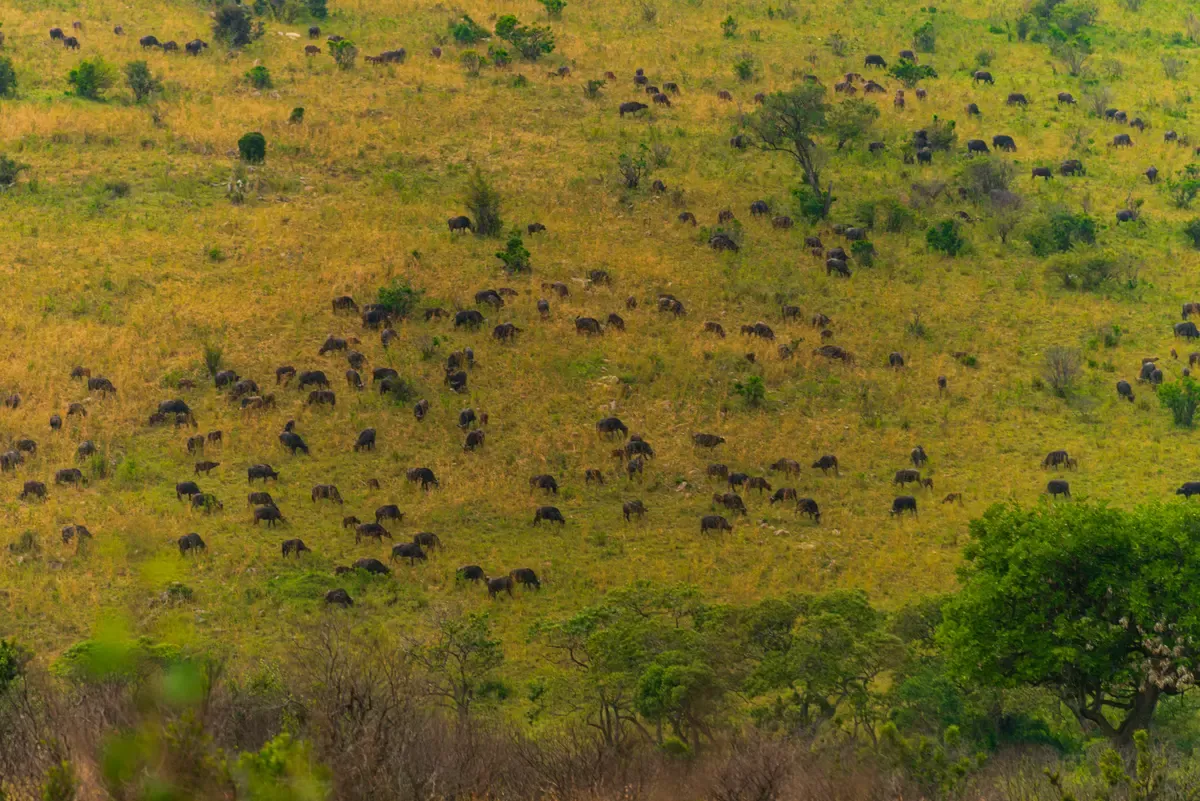
Wildebeest herd on a hillside in the Maasai Mara, near the Tanzanian border. Photo: Daniel Case, CC BY-SA 4.0, via Wikimedia Commons
When is the wildebeest migration in the Masai Mara?
Mara Conservancy says the herds reach the Mara Triangle around June, and tour listings place the migration in the reserve from about July to November.
The Great Migration is the main reason travellers pick the second half of the year for a Masai Mara safari. Mara Conservancy counts the moving herds at 1,245,000 wildebeest, 200,000 Burchell's zebra, 18,000 eland and 500,000 Thomson's gazelle. The herds arrive in the Mara Triangle by the Sand River around June and move on to the Mara River within days. The 3-Day Maasai Mara Group Safari in a 4WD Jeep lists the herds arriving in July and leaving in November. The 3-Day Maasai Mara Budget Camping Safari gives June to November. River crossings cannot be predicted. Herds may cross several times in one day and then wait on the bank for days. A safari of 2 or 3 days gives you more than one morning at the river.
How to time a river-crossing safari
Book July to October if a crossing is your top priority, and accept that the river banks draw a queue of vehicles. If you would trade some risk for fewer vehicles, late June is the quieter pick, with the herds at the Sand River and the $100 daily fee still in force until 30 June. In every case, book camps and group safaris well ahead, because the busy months fill first.
The 3-Day Maasai Mara Safari with Private Tents runs a full-day game drive from 7:00 to 16:00 on day 2, which gives the most time near the river.
Source: Mara Triangle.
How busy is the Masai Mara in peak season, and how do I avoid the crowds?
July to October is the busiest stretch of the year, and you beat the worst of it by travelling in late June or by staying in a conservancy outside the main reserve.
July to October is when most vehicles are in the reserve, because the migration draws them to the Mara River. The crossing points attract a queue of vehicles on good mornings. The Mara Triangle manages pressure with rules. Off-road driving is prohibited in a High-Use Zone. In a Low-Use Zone you may approach cats to within 25 metres. When more than five vehicles wait at a sighting, viewing time is limited to 10 minutes and waiting vehicles stay 100 metres back. Two tactics do most of the work. First, shift your dates. Late June gives you dry ground and the first herds before the July rise in fees and traffic. Second, shift your base. The conservancies bordering the reserve take fewer guests and offer bush walks and village visits alongside game drives.
Crowd-avoidance plan by traveller
Migration seekers should accept the crowds at the river and find quiet elsewhere by basing in a conservancy. Photographers can pick late June, when the first herds arrive and vehicles are fewer, or the 4:00 to 6:00 PM sunset drive that the 3-Day Maasai Mara Group Safari in a 4WD Jeep runs on day 1. Anyone travelling from July to October should book early, because the best-rated camps fill first.
Source: Mara Triangle.
What is the weather like in the Masai Mara?
June to October brings warm dry days, while Kenya's long rains fall from March to May and the short rains from October to December.
The Kenya Meteorological Department reports two rainy seasons, the March to May long rains and the October to December short rains. Between the rains, June to October is the dry stretch that most safaris are planned around. Weather changes what you can do on the ground, not just how comfortable you feel. Rain from March to May and again from November can make driving tracks difficult. Some camps close for part of the long rains, so check your camp is open before you book those months.
Travelling in the long rains
If March to May is your only window, consider flying in rather than taking a long road transfer, because the tracks suffer in the wet. Mara Conservancy lists six airlines with daily scheduled flights to the Mara: Air Kenya, Safarilink, Fly540, Mombasa Air Services, Aeronav and Boskovic Air Charters. Flying skips the worst roads and leaves more time in the reserve.
The green season has an upside for the right traveller. Reserve fees stay at $100 per adult per day until 30 June, the plains are green and the reserve is quiet. Photographers who want storms, green grass and empty tracks get better conditions then than in the dusty months.
Sources: Kenya Meteorological Department, Mara Triangle.
What is the cheapest time to visit the Masai Mara?
January to June is the cheapest time for reserve fees, at $100 per non-resident adult per day against $200 from 1 July.
Reserve entry fees move with the calendar. Non-resident adults pay $100 per person per day in the Mara Triangle from 1 January to 30 June, rising to $200 per person per day from 1 July to 31 December. Children aged 9 to 17 pay $50 in both seasons. Tour prices on this site do not change by month, but the fee line does. The 3-Day Maasai Mara Safari with 4WD Land Cruiser costs $228 per person. Its listing adds park fees of $200 per person from January to June and $400 per person from July to December. The trade-off is the weather. March to May is the long rains, and rain can make tracks difficult. If you want lower fees and dry ground at once, look at late June, before fees rise on 1 July.
What a 3-day safari costs by season
The tour prices below are per person and do not change by season. The park fee column repeats what each listing says about the reserve fee on top.
| Tour | Price | Park fees |
|---|---|---|
| 3-Day Group Joining Safari with a Land Cruiser | $183 | Extra, or book the option with fees |
| 3-Day Maasai Mara Group Safari in a 4WD Jeep | $199 | Extra for 2 nights, or book the option with fees |
| 3-Day Maasai Mara Safari with Private Tents | $228 | $200 per person January to June, $400 July to December |
| 3-Day Maasai Mara Budget Camping Safari | $238 | $100 per person per day January to June, $200 per day July to December |
| 3-Day Small Group Safari at Jambo Mara Lodge | $570 | In cash: $200 per adult January to June, $400 July to December |
Source: Mara Triangle.
Tours That Fit
Three-day group safaris that work in every season, with free cancellation if your dates shift.
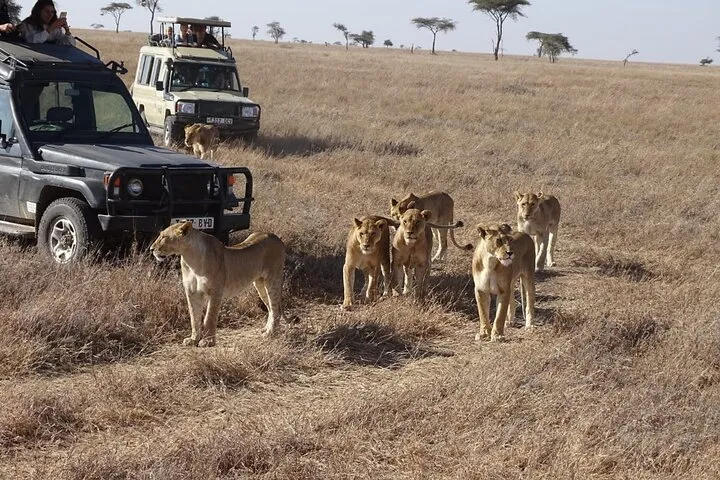 from $183
Most reviewed
3 days group joining safari to Maasai Mara with a Land Cruiser Jeep
The rare group joining Maasai Mara safari that uses a Land Cruiser 4x4 jeep instead of a minivan, from $183 per person with a 4.9 rating.
Check Availability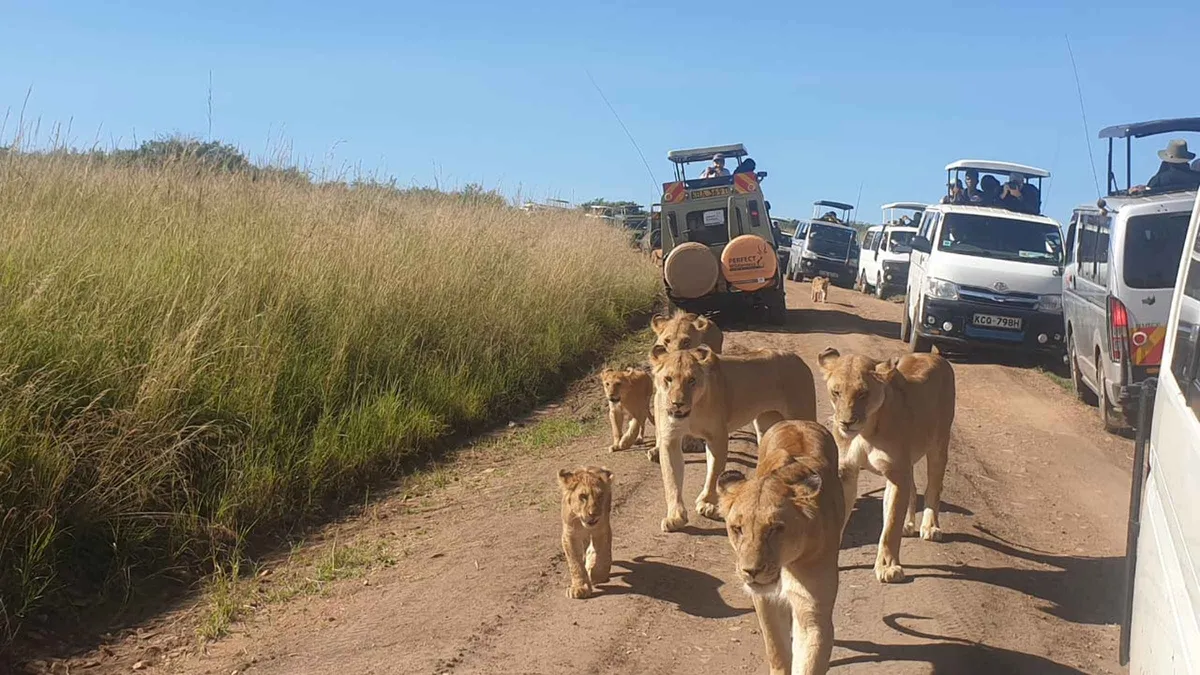 from $199
Editor's pick
3 Days 2 Nights Maasai Mara Group Safari in a 4WD Jeep
Budget 3-day Mara group safari with guaranteed daily departures, a full-day game drive, Mara River visit and optional Maasai village stop, but park fees are a separate option.
Check Availability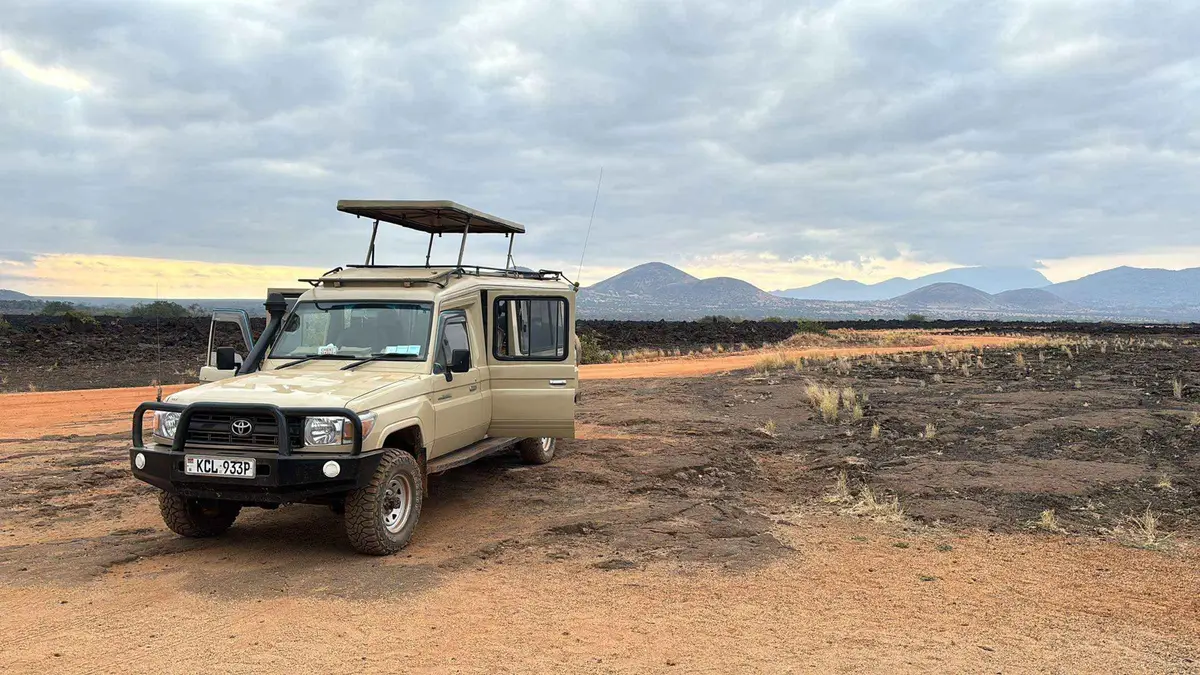 from $238
Budget camp
3-Days Maasai Mara Group Safari by 4WD
Budget 3-day group safari in a pop-up roof 4x4 with sunset plus full-day game drives, but park fees of $100-200 per day are paid separately.
Check AvailabilityWhen should different travellers go?
Migration seekers go July to October, budget travellers go January to June, and photographers who want quiet tracks go in late June or the green season.
There is no single best month for everyone. Pick the window that matches what you most want from your Masai Mara safari.
One plan per traveller type
Migration seeker: July to October, booked well ahead, with a conservancy base to escape the vehicle queues between crossings.
Budget traveller: January to June, when the reserve fee is $100 per adult per day instead of $200. Avoid March to May if you want dry roads.
Photographer: late June for the first herds with fewer vehicles, or the green months for storms and empty plains.
Family: children aged 9 to 17 pay $50 per day and children up to 8 enter free. The Overnight Maasai Mara Safari from Nairobi sells child places from age 3.
If you only have one day in Kenya, the Maasai Mara Day Trip with Maasai Village runs 13 hours and works best in the dry months, when tracks are reliable and animals gather near water.
Source: Mara Triangle.
What is the best time to visit the Masai Mara and the Serengeti together?
Plan the Mara leg for July to October, when tour listings place the herds on the Kenyan side of the border.
A two-country trip works best when the migration is in Kenya. Mara Conservancy puts the herds at the Sand River around June, and tour listings place them in the Mara from about July to November. Earlier in the year the herds are south of the border, so a combined itinerary should follow the herds rather than fight them. If your dates are fixed, take June to October for the Mara leg and see the Masai Mara safari options for a road or lodge trip. Build slack into the plan. Crossings and herd movements cannot be predicted, so an extra day in each park is worth more than a packed schedule.
Border and entry notes
Kenya eTA applications go only through etakenya.go.ke or the Kenya Travel Authorisation mobile app, and the eTA starts at $30 for normal processing. Applications are generally processed within 72 hours. Direct travel from the United States does not require a yellow fever vaccine for Kenya entry, but CDC recommends it for travellers aged 9 months and over going beyond Nairobi.
Sources: Mara Triangle, eTA Kenya, CDC Travelers' Health.
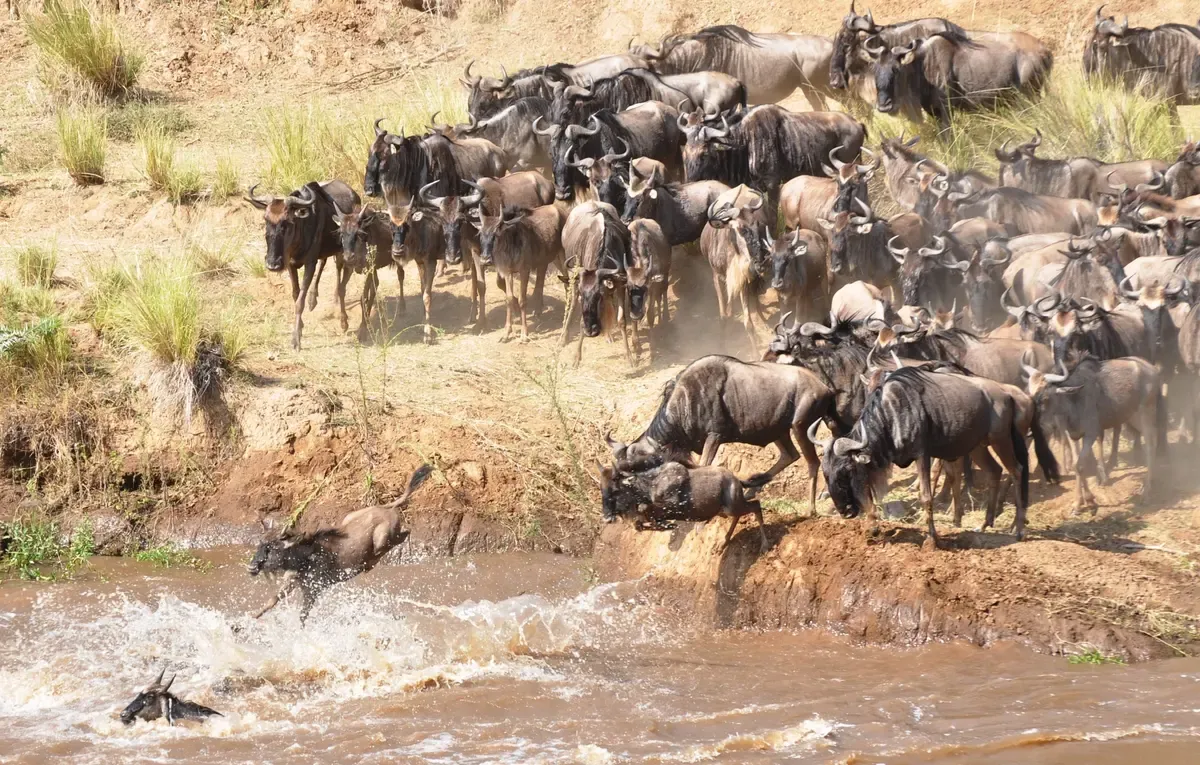
Wildebeest preparing to cross the river during the Great Migration. Photo: Naturaltracksafaris, CC BY-SA 4.0, via Wikimedia Commons
Your Month Questions, Answered
Is June a good time to visit Masai Mara?
Yes. June is dry, the herds reach the Mara Triangle by the Sand River around June, and non-resident entry is still $100 per day until 30 June. The 3-Day Maasai Mara Group Safari in a 4WD Jeep departs daily all year.
Is May a good time to visit Masai Mara?
It is a budget pick with a catch. May falls in the March to May long rains, and rain can make driving tracks difficult. The reserve fee is $100 per adult per day, and the 3-Day Maasai Mara Budget Camping Safari runs year-round.
Is April a good time to visit Masai Mara?
Only if price matters most. April sits in the long rains, some camps close for part of that season, and tracks can be hard going. In return you get the $100 daily fee and quiet green plains. See the weather section before you book.
Is February a good time to visit Masai Mara?
Yes, for a quiet safari. February falls in the dry spell between the short and long rains, crowds are low, and the reserve's resident wildlife stays all year. The fee is $100 per adult per day, see the month table.
Is December a good time to visit Masai Mara?
December works if you carry rain plans. It sits in the October to December short rains, so rain can make driving tracks difficult, and non-resident fees are at the $200 daily rate until 31 December. See the month table.
When do wildebeest cross the Mara River?
Crossings follow the herds, which tour listings place in the reserve from about July to November. They cannot be predicted, so give yourself 2 or 3 days near the river. The 3-Day Maasai Mara Safari with Private Tents runs a full-day drive from 7:00 to 16:00 on day 2.
Where should I stay in the Masai Mara?
Inside the reserve for the shortest drives to the river, or in a conservancy for fewer vehicles and bush walks. In the Mara Triangle, fees are paid according to where you stay, and the Triangle takes only M-Pesa and credit card. Lodge stays start with the 3-Day Small Group Safari at Jambo Mara Lodge.
What do I need to enter Kenya for a safari?
Apply for the Kenya eTA only through etakenya.go.ke or the official mobile app before you fly. It starts at $30. Direct travel from the United States does not require a yellow fever vaccine for entry. Compare Masai Mara safaris once your papers are in order.
More Guides
- Is a Masai Mara Safari Worth It?
Is a Masai Mara safari worth it in 2027? 3-day trips from $183, the migration months and a reserve fee that doubles in July. Read the verdict first.
- Masai Mara Safari vs Serengeti Safari: Which Is Better?
Kenya or Tanzania for a 2027 safari? Fee seasons, the June herd arrival, the 12-hour ticket and which side suits which trip. Compare both.
- 2-Day Masai Mara Safaris from Nairobi
2-day Masai Mara safaris from Nairobi for 2027: 1 night, an evening game drive, park fees and pickup zones compared. Check availability.